Cavernous and Venous Malformations
Cavernous and Venous Malformations
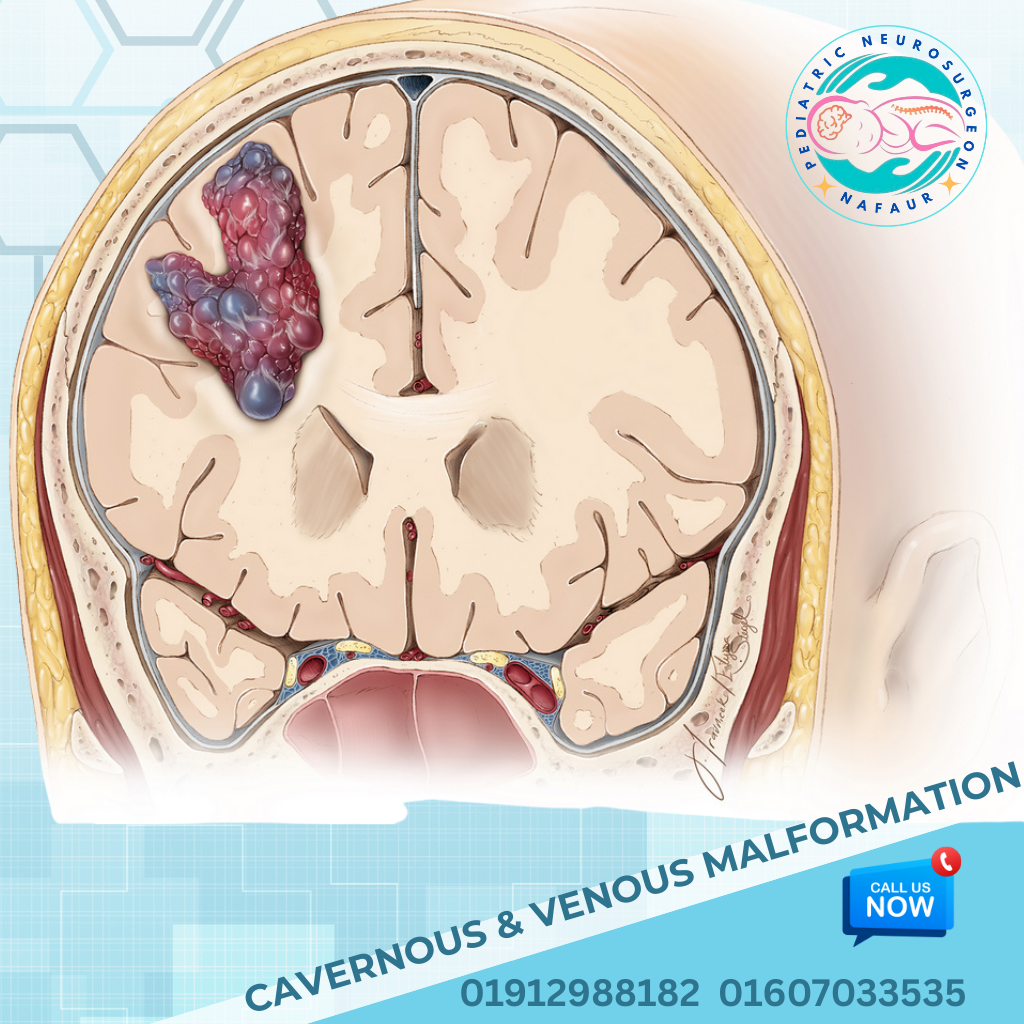
Cavernous malformations (also known as cavernomas or cavernous angiomas) and venous malformations are types of vascular anomalies that can occur in the brain and spinal cord. These are abnormally formed blood vessels that pose significant risk to a child’s health if they bleed or grow. Cavernomas consist of tightly packed, dilated blood vessels without normal intervening brain tissue, while venous malformations are enlarged, thin-walled veins that drain abnormally. In children, these malformations can be congenital (present at birth) or develop during early childhood, often presenting with seizures, headaches, neurological deficits, or even intracranial hemorrhage. In the Bangladesh healthcare setting, many of these cases remain undiagnosed or misdiagnosed due to lack of awareness or access to pediatric MRI. That’s why Dr. Md. Nafaur Rahman is leading efforts in early diagnosis, minimally invasive microsurgery, and long-term neurorehabilitation for children affected by cavernous and venous malformations. 🌍 Pediatric Vascular Malformations in the Bangladesh Context In Bangladesh, pediatric cavernomas and venous malformations are under-recognized due to: ⏳ Misdiagnosis as epilepsy, brain tumor, or trauma 🧠 Limited access to pediatric neuroimaging in district hospitals 🏥 Inadequate surgical expertise in pediatric vascular malformations 🧬 Low awareness of familial cavernomatosis or genetic syndromes 💸 Financial barriers to long-term follow-up or surgical intervention Despite these challenges, Dr. Nafaur Rahman provides specialized care at both National Institute of Neurosciences & Hospital (NINS) and Bangladesh Paediatric Neurocare Centre, ensuring international-standard treatment at an affordable cost. 🧬 Types of Pediatric Vascular Malformations Treated 🔹 Cavernous Malformations (Cavernomas): Located in brain (cerebral cavernoma) or spinal cord (spinal cavernoma) May be solitary or multiple Can be familial (inherited) in some cases Prone to recurrent bleeding, especially in the brainstem or cortex 🔹 Venous Malformations: Most common cerebral vascular anomaly May exist in isolation or alongside cavernomas Usually low-risk but may cause mass effect or complicate other surgeries Often identified incidentally on MRI with contrast ⚠️ Symptoms of Cavernous & Venous Malformations in Children The symptoms depend on the size, location, and bleeding history of the lesion: ⚡ Seizures or epilepsy, especially in cerebral cavernomas 🤕 Persistent headaches 🦵 Weakness in limbs or facial droop 🧍 Gait disturbances or imbalance 👁️ Visual disturbances if near the optic pathways 😵 Loss of consciousness or sudden neurological decline 📈 Increased intracranial pressure in larger lesions or rebleeding 🧒 Developmental delay or cognitive decline in younger children “A single seizure in a child may be the tip of the iceberg. A cavernoma or venous anomaly should always be ruled out with MRI.” — Dr. Md. Nafaur Rahman 🏥 Diagnosis of Pediatric Cavernous & Venous Malformations at NINS Early diagnosis is key to preventing rebleeding and permanent neurological deficits. Dr. Nafaur Rahman uses advanced diagnostic tools tailored to children: 🔍 Key Investigations: MRI with susceptibility-weighted imaging (SWI) – Best for detecting cavernomas MRV (Magnetic Resonance Venography) – Evaluates venous drainage patterns CT Scan – Sometimes used in acute bleeding Digital Subtraction Angiography (DSA) – Rarely needed but used in complex venous anomalies Genetic counseling/testing – For familial cavernomatosis in select cases 🛠️ Treatment & Surgical Management in Children ✅ Non-surgical Observation (For select cases): Asymptomatic cavernomas or venous malformations in non-eloquent areas Annual MRI surveillance Antiepileptic medication if seizures are present Avoidance of trauma, high-impact sports, or blood thinners 🔧 Surgical Indications: Recurrent hemorrhage Progressive neurological deficits Medically refractory seizures Lesions in accessible brain or spinal locations Mass effect causing increased ICP 🧠 Surgical Techniques by Dr. Nafaur Rahman: Microsurgical resection of cavernomas with neuronavigation Minimally invasive craniotomy or keyhole approaches Intraoperative neuromonitoring in eloquent cortex resections Spinal cavernoma excision preserving spinal cord function Endoscopic assistance in deep-seated lesions Preservation of venous drainage in venous malformations to avoid complications “Surgery in children isn’t just about removing the lesion—it’s about preserving development, cognition, and quality of life.” — Dr. Md. Nafaur Rahman 🔁 Postoperative Recovery & Long-Term Care Children undergoing surgery for vascular malformations typically recover well with proper follow-up: Post-op ICU monitoring for 24–48 hours Neurological assessment and imaging after 1–3 months Antiepileptic tapering in seizure-free cases Rehabilitation therapy for speech, motor, and cognition if needed Psychological support and academic reintegration 🚨 Complications If Left Untreated Without appropriate diagnosis and management, these vascular lesions can lead to: Recurrent hemorrhagic strokes Permanent brain damage Drug-resistant epilepsy Spinal cord compression and paralysis Neurodevelopmental disorders Reduced academic and social functioning 👨⚕️ Why Choose Dr. Md. Nafaur Rahman for Pediatric Vascular Neurosurgery? 🧠 One of Bangladesh’s few experts in pediatric cavernoma and vascular malformation surgery 🏥 Operates at NINS, Bangladesh’s leading neuroscience facility 🧒 Uses child-centered approaches, including minimal blood loss and rapid recovery protocols 🎯 Experienced in brainstem, spinal cord, and eloquent cortex cavernomas 💬 Provides empathetic care to families throughout diagnosis, treatment, and recovery 📞 Contact for Evaluation or Surgery of Pediatric Vascular Malformations Dr. Md. Nafaur Rahman Assistant Professor, Pediatric Neurosurgery, NINS Chief Consultant, Bangladesh Paediatric Neurocare Centre 📱 For Serial/Appointment: 📞 01912988182 | 📞 01607033535 🌐 Website: www.neurosurgeonnafaur.com
Patient Reviews on Cavernous and Venous Malformation
Before & After Videos on Cavernous and Venous Malformation
All Patient Reviews
(শিশু নিউরোসার্জারির সকল রোগীদের রিভিও ভিডিও)
All Chamber Addresses & Appointment Number
(সকল চেম্বারের ঠিকানা সমূহ ও সিরিয়াল নাম্বার)
Cavernous and Venous Malformation Related Blog
- Moyamoya Diseases or Paediatric Stroke