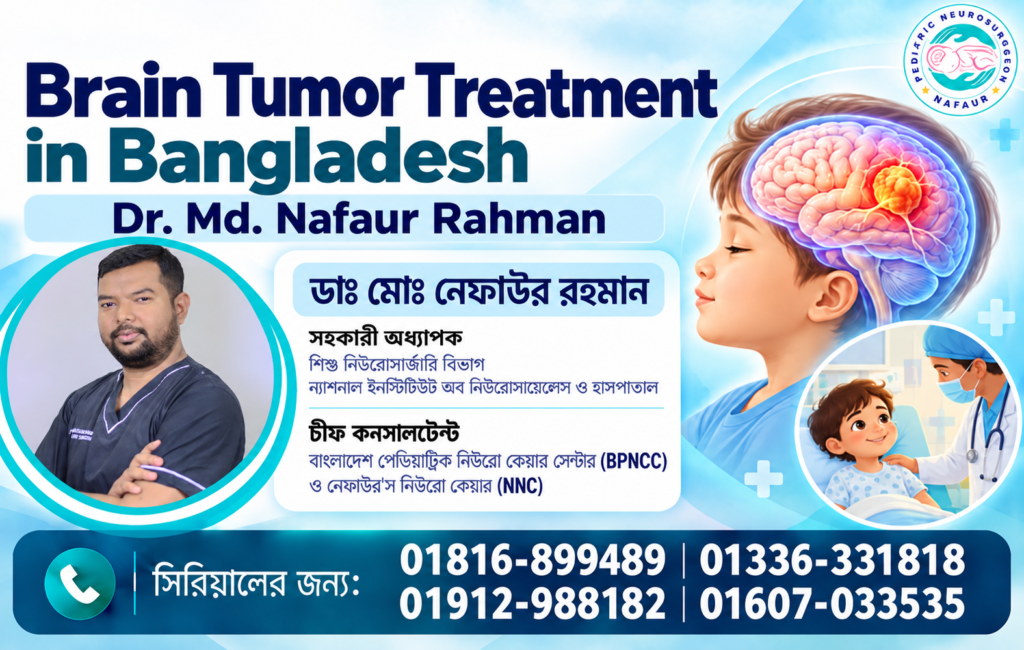
Brain Tumor Treatment in Bangladesh by Pediatric Neurosurgeon Dr. Md. Nafaur Rahman
Brain tumors are among the most serious neurological conditions affecting children. Although pediatric brain tumors are relatively uncommon compared with some other childhood diseases, they require early diagnosis, careful imaging, multidisciplinary assessment and specialized neurosurgical treatment.
For parents searching for Brain Tumor Treatment in Bangladesh, Pediatric Brain Tumor Treatment in Bangladesh, Child Brain Tumor Surgery in Dhaka, or an experienced Pediatric Neurosurgeon in Bangladesh, understanding the disease and available treatment options is essential.
Dr. Md. Nafaur Rahman is a pediatric neurosurgeon in Bangladesh whose clinical practice includes the evaluation and surgical treatment of pediatric brain tumors along with a wide range of other pediatric neurosurgical conditions.
He serves as:
Assistant Professor
Department of Paediatric Neurosurgery
National Institute of Neurosciences & Hospital
and
Chief Consultant
Bangladesh Paediatric Neurocare Centre (BPNCC)
Chief Consultant
নেফাউর’স নিউরো কেয়ার (NNC)
Families seeking specialized pediatric neurosurgical assessment for a child with a suspected or diagnosed brain tumor may consider consultation with Dr. Md. Nafaur Rahman.
What Is a Pediatric Brain Tumor?
A brain tumor is an abnormal growth of cells inside the brain or surrounding structures.
Brain tumors in children are different from brain tumors in adults in several important ways. The types of tumors, their locations, biological behavior, symptoms and treatment strategies can differ considerably.
A pediatric brain tumor may be:
- Benign
- Low grade
- High grade
- Slow growing
- Rapidly growing
- Localized
- Infiltrative
Even a histologically benign tumor can sometimes cause serious problems if it compresses important parts of the brain, blocks cerebrospinal fluid circulation or affects structures responsible for movement, vision, hormone production, swallowing or breathing.
For this reason, the word “benign” does not always mean that the tumor can safely be ignored.
Brain Tumor Treatment in Bangladesh
The management of a pediatric brain tumor usually depends on:
- Child’s age
- Tumor location
- Tumor size
- Tumor type
- Neurological condition
- MRI findings
- Presence of hydrocephalus
- Histopathology
- Molecular characteristics in selected tumors
- Whether the tumor can be safely removed
- Overall health of the child
Treatment may include surgery, chemotherapy, radiotherapy or a combination of these approaches.
For many pediatric brain tumors, neurosurgery plays an important role in diagnosis and treatment.
Common Types of Brain Tumors in Children
Children can develop several types of brain tumors.
Pilocytic Astrocytoma
Pilocytic astrocytoma is a common low-grade brain tumor in children.
It may occur in the cerebellum, optic pathways, brainstem or other locations.
When the tumor is located in an accessible area, surgical removal may provide very good disease control in many cases.
Medulloblastoma
Medulloblastoma is an important malignant pediatric brain tumor that commonly arises in the posterior fossa.
Children may present with:
- Headache
- Repeated vomiting
- Balance problems
- Walking difficulty
- Hydrocephalus
- Abnormal eye movements
Treatment commonly involves surgery followed by oncology-directed therapy according to age, pathology and risk classification.
Ependymoma
Ependymoma may arise within or near the ventricular system.
These tumors can obstruct cerebrospinal fluid flow and cause hydrocephalus.
Surgical removal is often a major component of treatment, with additional therapy depending on the individual case.
Craniopharyngioma
Craniopharyngioma usually develops near the pituitary gland and optic pathways.
It may cause:
- Headache
- Vision problems
- Growth abnormalities
- Hormonal problems
- Increased thirst
- Excessive urination
- Hydrocephalus
Treatment planning often requires close collaboration between neurosurgery, endocrinology, ophthalmology and oncology.
Brainstem Tumors
Brainstem tumors can produce symptoms such as:
- Weakness
- Facial asymmetry
- Difficulty swallowing
- Abnormal eye movement
- Walking problems
- Coordination difficulties
Management depends greatly on the exact type and location of the lesion.
Germ Cell Tumors
Intracranial germ cell tumors may arise in regions such as the pineal or suprasellar area.
These tumors may cause hydrocephalus, visual symptoms, endocrine abnormalities and other neurological problems.
The treatment strategy depends on diagnosis and tumor subtype.
Symptoms of Brain Tumor in Children
Brain tumor symptoms vary depending on the child’s age, tumor location and rate of growth.
Parents should be aware of persistent or progressive symptoms.
Persistent Headache
Repeated headaches, particularly when worsening over time or associated with vomiting, deserve medical assessment.
Early Morning Vomiting
Repeated vomiting, especially in the early morning or when associated with headache, may indicate increased intracranial pressure.
Balance and Walking Problems
Tumors affecting the cerebellum or brainstem can cause:
- Unsteady walking
- Frequent falling
- Poor coordination
- Difficulty standing
Vision Problems
A child may develop:
- Blurred vision
- Double vision
- Reduced vision
- Abnormal eye movement
- Squint
Seizures
A first seizure may occasionally be the presenting symptom of a brain tumor.
Weakness
Weakness of one side of the body, facial asymmetry or reduced limb movement requires neurological assessment.
Behavioral or School Performance Changes
Some children develop:
- Personality changes
- Irritability
- Loss of concentration
- Decline in school performance
- Excessive sleepiness
Increasing Head Size in Babies
In infants, a brain tumor can sometimes cause hydrocephalus and progressive head enlargement.
Brain Tumor and Hydrocephalus
One important complication of pediatric brain tumors is hydrocephalus.
Tumors located around the posterior fossa, third ventricle, aqueduct, pineal region or other CSF pathways can obstruct normal cerebrospinal fluid circulation.
This can lead to:
- Enlarged ventricles
- Headache
- Vomiting
- Drowsiness
- Visual problems
- Increasing head circumference in babies
- Reduced consciousness in severe cases
Some children may require treatment of hydrocephalus before or during brain tumor surgery.
Possible procedures may include:
- External ventricular drainage
- VP shunt
- Endoscopic Third Ventriculostomy
- Tumor removal itself
The correct strategy depends on the clinical circumstances.
How Is a Pediatric Brain Tumor Diagnosed?
Diagnosis begins with clinical assessment and neurological examination.
The doctor evaluates:
- Symptoms
- Duration of symptoms
- Motor function
- Balance
- Cranial nerves
- Vision
- Development
- Level of consciousness
- Signs of increased intracranial pressure
MRI Brain
MRI is one of the most important investigations for suspected pediatric brain tumors.
MRI helps identify:
- Tumor location
- Tumor size
- Relationship with important structures
- Hydrocephalus
- Spread within the nervous system
- Characteristics that may suggest a particular tumor type
In selected situations, specialized MRI sequences may also be useful.
CT Scan
CT scanning may be useful in emergency situations because it can rapidly identify:
- Brain masses
- Hydrocephalus
- Bleeding
- Calcification
- Severe mass effect
However, MRI usually provides more detailed soft-tissue information.
Why Is Histopathology Important?
Brain imaging can suggest the likely diagnosis, but definitive tumor classification often requires tissue analysis.
During surgery or biopsy, a tissue sample may be collected.
The pathology report helps determine:
- Tumor type
- Tumor grade
- Biological behavior
- Need for additional treatment
In modern neuro-oncology, molecular testing can also be important for some tumors.
Is Surgery Necessary for Every Pediatric Brain Tumor?
No.
Not every child with a brain tumor requires immediate surgery.
Treatment depends on the tumor type, location, symptoms and biological characteristics.
However, surgery may be recommended when it is necessary to:
- Remove the tumor
- Reduce tumor burden
- Obtain tissue for diagnosis
- Relieve pressure on the brain
- Treat obstructive hydrocephalus
- Improve neurological symptoms
In some tumors, biopsy rather than complete removal may be safer.
Goals of Pediatric Brain Tumor Surgery
The objective of surgery is not simply to remove as much tissue as possible.
The neurosurgeon must balance tumor removal against preservation of neurological function.
The goals may include:
- Maximum safe tumor removal
- Tissue diagnosis
- Relief of intracranial pressure
- Restoration of CSF circulation
- Protection of neurological function
- Preparation for further oncology treatment
Maximum safe resection is an important concept in pediatric brain tumor surgery.
Removing more tumor is not beneficial if doing so creates unacceptable neurological injury.
Challenges of Pediatric Brain Tumor Surgery
Children are not simply smaller adults.
Pediatric brain tumor surgery requires attention to:
- Developing brain anatomy
- Blood volume
- Fluid balance
- Body temperature
- Pediatric anesthesia
- Tumor location
- Neurological preservation
- Postoperative monitoring
Small children and infants require especially careful perioperative management.
Posterior Fossa Brain Tumor in Children
The posterior fossa is a common location for pediatric brain tumors.
Tumors in this region may affect the:
- Cerebellum
- Brainstem
- Fourth ventricle
- Cranial nerves
Children may present with:
- Headache
- Vomiting
- Walking difficulty
- Poor coordination
- Abnormal eye movements
- Hydrocephalus
Posterior fossa surgery requires detailed anatomical planning because many vital structures are located in a small space.
Brain Tumor Surgery and Pediatric Anesthesia
Parents often worry about anesthesia during brain surgery.
Pediatric neurosurgical anesthesia requires careful monitoring of:
- Oxygenation
- Blood pressure
- Blood loss
- Body temperature
- Fluids
- Electrolytes
- Intracranial pressure
- Ventilation
The anesthetic plan depends on the child’s age, weight, medical condition and type of surgery.
What Happens After Brain Tumor Surgery?
Following surgery, the child may require close monitoring.
Doctors assess:
- Level of consciousness
- Limb movements
- Cranial nerve function
- Speech
- Swallowing
- Balance
- Vision
- Surgical wound
- Signs of hydrocephalus
Postoperative imaging may be performed to evaluate residual tumor and surgical results.
Is Chemotherapy Needed After Surgery?
Some pediatric brain tumors require chemotherapy.
The decision depends on:
- Tumor pathology
- Tumor grade
- Child’s age
- Amount of residual tumor
- Molecular characteristics
- Disease spread
Chemotherapy planning is usually managed by a pediatric oncology team.
Is Radiotherapy Needed?
Radiotherapy may be required for certain pediatric brain tumors.
However, because radiation can affect the developing brain, the decision requires careful consideration of:
- Age
- Tumor type
- Tumor location
- Risk category
- Long-term effects
Radiation treatment should be individualized.
Importance of Multidisciplinary Pediatric Brain Tumor Care
Successful brain tumor management often requires collaboration between multiple specialties.
The treatment team may include:
- Pediatric neurosurgeon
- Pediatric oncologist
- Radiation oncologist
- Pediatric neurologist
- Pediatric anesthesiologist
- Neuroradiologist
- Neuropathologist
- Endocrinologist
- Ophthalmologist
- Physiotherapist
- Rehabilitation team
This multidisciplinary approach helps address both the tumor and the child’s overall development and neurological function.
When Should Parents Seek Urgent Medical Care?
Parents should seek prompt medical assessment if a child develops:
- Persistent severe headache
- Repeated vomiting
- Increasing drowsiness
- New seizures
- Sudden weakness
- Loss of balance
- Difficulty walking
- Visual deterioration
- Abnormal behavior
- Reduced consciousness
These symptoms do not always mean a brain tumor is present, but they require medical evaluation.
Why Should a Child With Brain Tumor Be Evaluated by a Pediatric Neurosurgeon?
Pediatric neurosurgery focuses specifically on neurological surgical disorders affecting newborns, infants, children and adolescents.
Children with brain tumors have different anatomical, physiological and developmental considerations from adults.
A pediatric neurosurgeon evaluates not only whether surgery is possible, but also:
- How much tumor can be safely removed
- Whether hydrocephalus needs treatment
- Potential impact on development
- Neurological preservation
- Long-term follow-up needs
For these reasons, specialist pediatric neurosurgical assessment is particularly valuable.
Why Consider Dr. Md. Nafaur Rahman for Pediatric Brain Tumor Treatment in Bangladesh?
Families searching for Brain Tumor Treatment in Bangladesh, Pediatric Brain Tumor Surgery in Bangladesh, Pediatric Neurosurgeon in Dhaka, Child Brain Tumor Specialist Bangladesh, or Brain Tumor Surgeon for Children may consider consultation with Dr. Md. Nafaur Rahman.
His clinical practice focuses on pediatric neurosurgery and includes assessment and surgical management of:
- Pediatric brain tumors
- Hydrocephalus
- Spina bifida
- Myelomeningocele
- Encephalocele
- Craniosynostosis
- Pediatric spinal tumors
- Congenital brain abnormalities
- Neurovascular conditions
- Pediatric head injury
- Other complex pediatric neurosurgical disorders
Brain tumor treatment must always be individualized.
The safest surgical strategy depends on tumor location, pathology, neurological condition, age and imaging findings.
No surgeon or treatment can guarantee a particular outcome, and parents should receive a clear explanation of expected benefits, potential risks, alternatives and follow-up requirements.
Dr. Md. Nafaur Rahman – Professional Profile
Dr. Md. Nafaur Rahman
Assistant Professor
Department of Paediatric Neurosurgery
National Institute of Neurosciences & Hospital
Chief Consultant
Bangladesh Paediatric Neurocare Centre (BPNCC)
Chief Consultant
নেফাউর’স নিউরো কেয়ার (NNC)
Chamber Address – Bangladesh Paediatric Neurocare Centre
Bangladesh Paediatric Neurocare Centre (BPNCC)
44/7, City Tower, Level-10
West Panthapath
Dhaka-1205, Bangladesh
Google Map:
https://maps.app.goo.gl/u5BNHKGMr3D3cgUBA?g_st=ac
Chamber Address – নেফাউর’স নিউরো কেয়ার
নেফাউর’স নিউরো কেয়ার (NNC)
H # 24/1, Level # 7
Shyamoli Square
Shyamoli Cinema Hall Building
Mirpur Road, Shyamoli
Dhaka-1207, Bangladesh
Google Map:
https://maps.app.goo.gl/9NM8HQHS3y9Z3C3eA?g_st=ac
Appointment Numbers
For appointments and consultation:
01816-899489
01336-331818
01912-988182
01607-033535
Parents may contact the chamber to confirm consultation schedules and appointment availability.
Social Media Links of Dr. Md. Nafaur Rahman
Website:
https://www.neurosurgeonnafaur.com
Facebook:
https://www.facebook.com/NeurosurgeonNafaur
Instagram:
https://www.instagram.com/rahman.nafaur?igsh=MTNzd200emxwaWJycA==
TikTok:
https://www.tiktok.com/@pediatricneurosurgeon?_r=1&_t=ZS-95a2vtJMi28
YouTube:
https://www.youtube.com/channel/UCSlESZh6_NGITtE27rNwTBg
LinkedIn:
https://www.linkedin.com/in/nafaur-rahman-721b
Frequently Asked Questions About Pediatric Brain Tumors
Can a brain tumor in a child be treated successfully?
Many pediatric brain tumors can be treated effectively, but outcome depends on the tumor type, location, grade, extent of disease and the child’s overall neurological condition.
Does every brain tumor require surgery?
No. Some tumors require observation, biopsy, chemotherapy, radiotherapy or a combination of treatments. Surgery is recommended when it is clinically appropriate.
Can a benign brain tumor be dangerous?
Yes. Even a benign tumor can cause serious problems if it compresses vital brain structures or blocks CSF circulation.
Can a brain tumor cause hydrocephalus?
Yes. Brain tumors located near CSF pathways can obstruct fluid circulation and cause hydrocephalus.
Is MRI necessary for brain tumor diagnosis?
MRI is one of the most important investigations for evaluating pediatric brain tumors because it provides detailed information about tumor anatomy and surrounding structures.
Which doctor should treat a pediatric brain tumor?
A child with a suspected or confirmed brain tumor should be assessed by a team experienced in pediatric neuro-oncology. When surgery is being considered, evaluation by a pediatric neurosurgeon is particularly important.
Conclusion
Brain Tumor Treatment in Bangladesh requires accurate diagnosis, advanced imaging, careful surgical planning and multidisciplinary care.
Pediatric brain tumors differ significantly from adult tumors, and treatment decisions must consider the child’s age, development, neurological status, tumor location and pathology.
Some children require surgery alone, while others may need additional chemotherapy, radiotherapy or long-term rehabilitation.
For parents searching for Pediatric Brain Tumor Treatment in Bangladesh, Child Brain Tumor Surgery in Dhaka, Pediatric Neurosurgeon in Bangladesh, or specialist evaluation for a brain tumor, consultation with an experienced pediatric neurosurgeon can help determine the most appropriate treatment plan.
Families may consider Dr. Md. Nafaur Rahman for specialist pediatric neurosurgical assessment and treatment planning for brain tumors and other complex neurosurgical conditions affecting children.
Appointments:
01816-899489 | 01336-331818 | 01912-988182 | 01607-033535
Medical Disclaimer: This article is intended for general educational information only and does not replace medical consultation, diagnosis or individualized treatment. Pediatric brain tumor treatment varies according to tumor type, location, pathology, age and overall clinical condition.